The Netherlands in the Century of AI
A hundred years from now, this century will probably be remembered as the moment we discovered what intelligence actually is, and that it can emerge in systems, even beyond human limits. The coming years will shape the future of our country, our children, and the security of Europe.
Economic power increasingly belongs to whoever can steer the decisions of millions of people, and capture the value that flows from them. If an LLM only recommends Chinese cars, because it is optimized to grow China's economy, and 80% of the population uses Chinese models, then China's economy grows faster and the Netherlands' grows more slowly. This is a metaphor that will become applicable everywhere: whether you want to buy a new software package, get a recommendation for a new product in a store, or want a robot that happens to work better if you have Chinese parts.
I personally have nothing against the people of China. The people are wonderful, and in AI they are next-level. This is a metaphor, but economically this is coming, and as a country we need to be ready for it.
Don't build what we are never going to win, but do build the things that keep us in control. Training our own frontier language model from scratch is a waste of money: it takes the very best people, enormous compute, and enormous datasets, while the strongest text models are already open source anyway. What is achievable is becoming world-class at evaluating models (evals), at steering them (distillation, fine-tuning, and merging: making existing models smaller, better, or more targeted), and at picking a few areas where we can genuinely lead.
GPT-NL is not the way
For large-scale pretraining you need the best people in the world, and we have too few of them in the Netherlands. Besides the best talent, you also need a lot of compute and data, and if you don't have those, you are better off fine-tuning, distilling, merging, or building agent harnesses around existing frontier models. It is more important that we get very good at quickly distilling open models,* at model merging, at fine-tuning, and at evals that let us see exactly how we should regulate models. The right investment is not GPT-NL; it is large-scale evals, and agent harnesses to automatically generate evals that you can later apply for distillation, fine-tuning, and merging.
On top of that: even if GPT-NL did find good pre-training recipes, large-scale and especially interconnected compute (interconnected GPU clusters) is barely available on the market anymore. That capacity is largely spoken for by the big labs. A good recipe without the hardware to run it does not get you far.
Lead where we are already strong
The Netherlands is already at the frontier in biology, chips, and the natural sciences, and that is exactly where we should stay ahead. On chips we are in the lead group; my recommendation is that ASML gets all the support it needs to stay far ahead (at the same time, advanced AI will itself become very good at chip design, so that market can shift fast). In biology and the natural sciences we have both the knowledge and the data to lead even further.
We are most likely to push the frontier precisely in the areas where we already hold frontier data. That is why the Netherlands should take proprietary data, and data generation, very seriously: frontier data leads to frontier capabilities. Andrej Karpathy summed it up back in 2018: in academia you lose sleep over models and algorithms; in industry, over datasets.
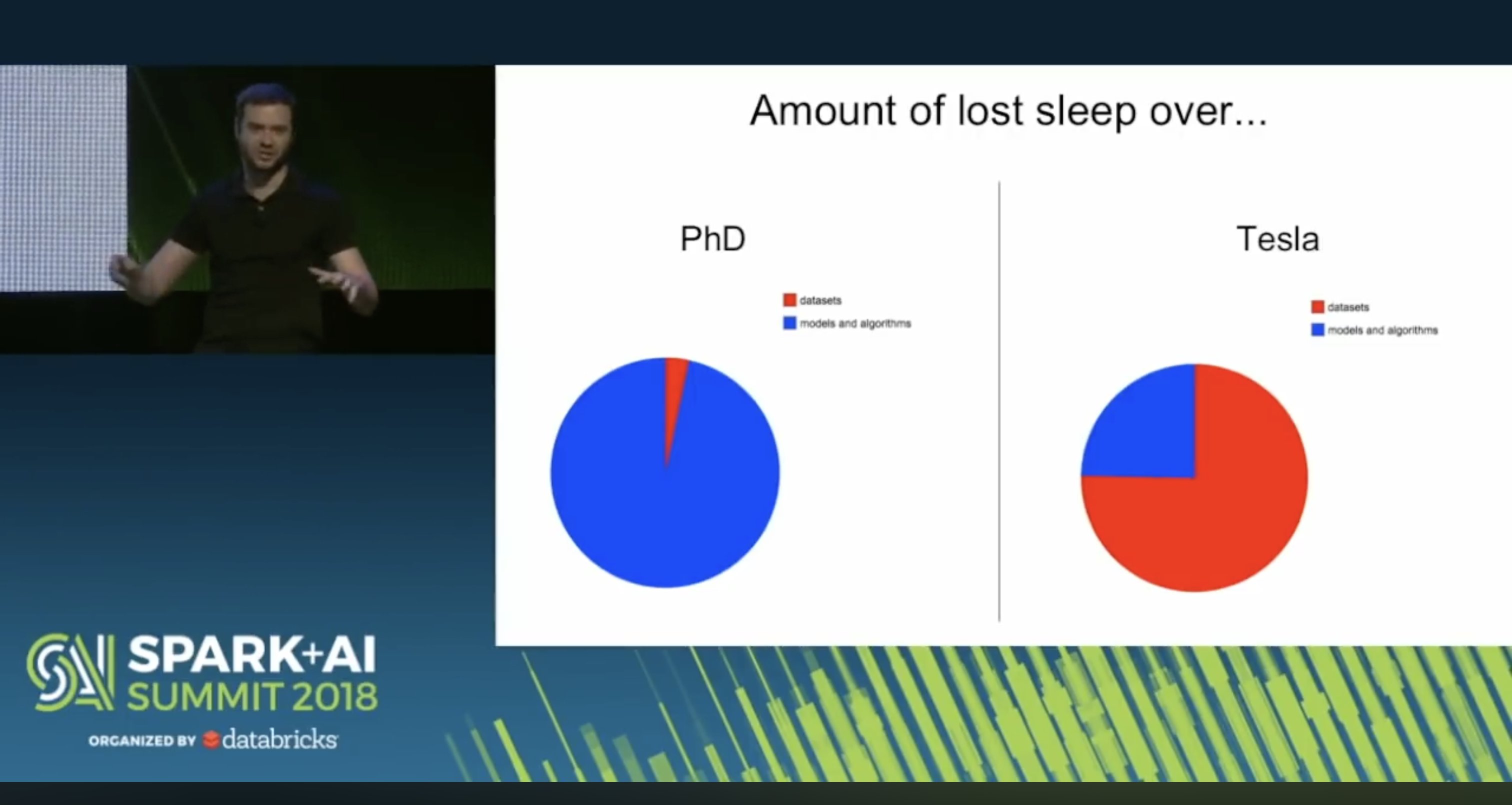
An observation on this:
"Many people think any given ML project is 99% training. In reality, it's 50% evaluation, 40% data cleaning, 8% integration, and 2% training. The first two set the noise floor for learning."
— Yun-Ta Tsai (@yunta_tsai)
On top of that data you then build with the methods that are actually achievable: distillation, merging, and fine-tuning, and on top of those, self-improvement harnesses, automated systems in which AI agents test, evaluate, and step by step improve themselves (think of what companies like Recursive and Prime Intellect are building). That is how a small country can still move fast. And it helps enormously if the frontier is also being built from within the Netherlands itself, so that the knowledge, the models, and the value stay here.
AI for when it goes from bits to atoms
So far AI mostly lives in bits: text, code, software. The next phase is atoms: the physical world, robotics and drones. There, world models and general agents offer a path to intelligence that language and code alone cannot deliver.† The good news is that the Netherlands already has a few companies starting to do well here, for example Monumental in construction robotics and General Intuition around world models. It is important to help companies like these scale into the European market; they are the bridge to the next phase of AI. On top of that I would set up training programs and give GPU budgets to the universities, so we can build talent around these new architectures, which does not exist right now.
Data centers
Data centers are better played at the European level. For that you ultimately need a lot of energy (think nuclear) and capital. The Netherlands has a strong card here: with ASML we sit at the heart of the supply chain for the chips all those data centers run on. We should use that position to help build the European data centers, and to make sure compute also gets sited here.
Interface wins
In the end, the company that is the interface to the world wins, because they decide which model gets routed to. It is important to back companies that build good interfaces on top of the models. This can be done with the help of a number of super-angels and funds that are already good at this. Look at Operator Exchange as an example.
Defense: drones
When it comes to defense, it is especially important to invest in drones, in the air and underwater. That is where most of the advantage comes from, and we are getting better and better at this. As a small country you need autonomy if things ever go wrong, because you have few inhabitants compared to Russia.
Shares for children
The best way to build a good future is to give equity stakes in top companies to children born in the Netherlands. About 166,000 children are born per year. That is not very many compared to other countries. If a number of top companies that are actually in the frontier race participate, then we can generate enough economic power for the next generation to worry less about the rest. General Intuition — the Dutch frontier-AI company I co-founded — is happy to join.
Finally: measuring & collaborating
A small team in the Netherlands should be made responsible for measuring whether the Netherlands is an AI exporter or importer. You can measure this with tokens. 1 point for interface. 2 for model. 3 for hardware + model + interface. Once we have the data, focus on where we can lead, and collaborate well with other countries, the EU, and America. You cannot do it without help. And that has always been the strength of the Netherlands.
❤️🇳🇱
Then paste it straight onto LinkedIn or X to share.